A website dedicated to the truth.
Odds of creating the simplest cell randomly
The Astronomical Odds of Spontaneously Forming the Simplest Living Cell
SCIENTIFIC
12/8/20254 min read
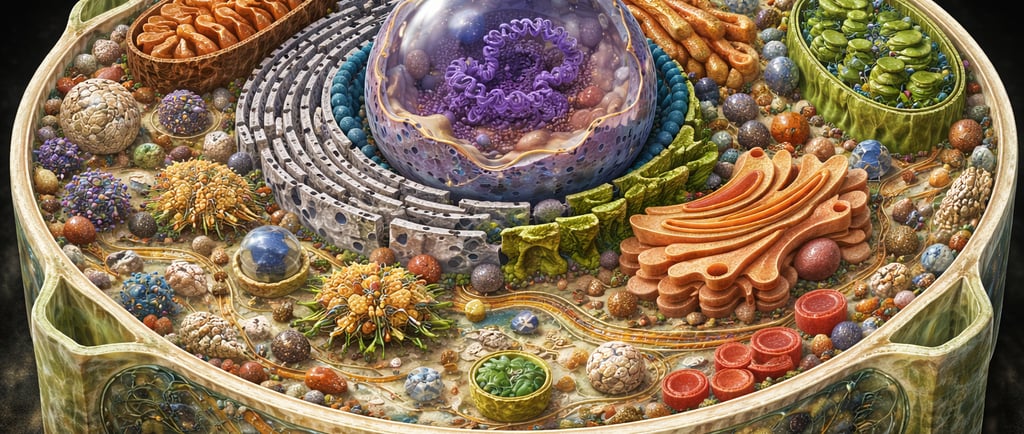
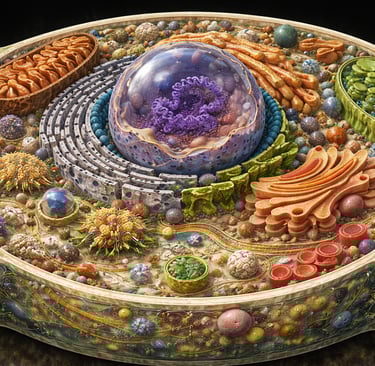
The Astronomical Odds of Spontaneously Forming the Simplest Living Cell
The origin of life from non-living matter—known as abiogenesis—remains one of the most profound unsolved mysteries in science. While experiments like Miller-Urey (1952) demonstrated that amino acids can form under simulated prebiotic conditions, assembling these building blocks into a functional, self-replicating cell involves staggering complexity. Estimates from biophysicists and molecular biologists suggest the probability of this occurring by random chemical processes alone is vanishingly small, often far below what could plausibly happen even over billions of years on early Earth.
The Simplest Known Cell: A Benchmark for Minimal Life
The bacterium Mycoplasma genitalium holds the record for the smallest genome of any free-living organism, with approximately 580,000 base pairs and 482 protein-coding genes. Studies using transposon mutagenesis identified around 382-387 genes as essential for basic life functions, including DNA replication, transcription, translation, energy metabolism, and minimal cellular transport. This makes it a common model for the "minimal cell"—the theoretical simplest self-sustaining, reproducing organism.
Even this pared-down cell requires hundreds of precisely sequenced proteins, a functional genome, and intricate molecular machinery. No simpler free-living cell is known, and parasitic organisms (like some viruses) rely on host cells, so they don't qualify as independent life.
Probability of Forming Essential Amino Acids and Proteins
Proteins are chains of amino acids, typically 150-400 in length for functional ones in minimal cells. Life uses only left-handed (L-form) amino acids, while prebiotic chemistry produces a racemic (50/50 left/right) mixture.
Chirality issue: The odds of randomly assembling 150 left-handed amino acids are about 1 in 10^45 (since each has a 50% chance).
Peptide bonds: Forming correct bonds (rather than other linkages) adds another ~1 in 10^45 penalty in some estimates.
Functional sequence: Not all chains fold into working proteins. Biophysicist Douglas Axe's experiments estimated that only 1 in 10^74 random 150-amino-acid sequences form a stable, functional fold.
Combining these for one modest protein yields odds around 1 in 10^164. A minimal cell needs hundreds of such proteins—multiplying probabilities makes the overall chance effectively zero, even ignoring assembly into a cell.
Critics note that prebiotic synthesis (e.g., Miller-Urey) produces amino acids readily, and functional proteins may tolerate sequence variations. However, these calculations assume random assembly; real prebiotic pathways would need guided chemistry, which remains undemonstrated for complex proteins.
Suitable Chemical Environment and Compartmentalization
Amino acids and nucleotides degrade quickly in water (hydrolysis). A protective environment—like lipid vesicles or mineral surfaces—is needed to concentrate and stabilize them. Lipids can self-assemble into membranes under certain conditions, but forming a stable protocell that encases functional machinery without leaking or bursting is another hurdle. In fact creating a protocell without the gates to allow the proper materials in, and keeping damaging materials out, would also not be able to function. Meaning this machinery would need to exist at the same time as the formation of the protocell.
The DNA (or RNA) Chain: Storing Genetic Information
A minimal genome like M. genitalium's (~580 kb) requires precise sequencing. Random polymerization of nucleotides would yield mostly non-functional chains. For a 500,000-base genome with 4 bases, total possibilities are 4^500,000—an incomprehensibly large number. The fraction encoding a viable minimal set is astronomically small (estimates exceed 1 in 10^100,000). Even RNA-world scenarios (RNA as both information and catalyst) face similar issues: synthesizing long, functional RNA ribozymes prebiotically is challenging due to unstable ribose and low-yield pathways.
Complex Machinery for Metabolism, Maintenance, and Reproduction
A living cell isn't just parts—it's orchestrated systems
Ribosomes (RNA-protein complexes) for translation.
Enzymes for metabolism (e.g., glycolysis, ATP production).
DNA/RNA polymerases for replication.
Membrane transporters and repair mechanisms.
These require coordinated assembly. Biophysicist Harold Morowitz calculated the odds of spontaneously forming a minimal cell with ~124 proteins as 1 in 10^340,000,000. Modern estimates align: the interdependent machinery creates "irreducible complexity" barriers, where partial systems confer no survival advantage.
Comparison to Human Technology
Humanity's most advanced creations pale beside a single cell:
Cells self-repair, self-replicate, and adapt—feats no human machine achieves autonomously even with the most brilliant minds and best engineers in the world. Imagine if a company could create a Car that self replicates, heals itself, and adapts to changes in the weather all on it's own. As one analysis notes, the cell's "software" (genetic code) and "hardware" (proteins) integrate information processing far beyond any computer. Biologist Michael Denton describes the cell as "a veritable micro-miniaturized factory containing thousands of exquisitely designed pieces of molecular machinery." And yet we are taught (incorrectly) that all this information, design and complexity, just happened by accident.
Counterarguments and the Scientific Consensus
Proponents of natural abiogenesis invoke vast time (hundreds of millions of years on early Earth), huge chemical "trials" (oceans as reactors), and stepwise pathways (e.g., RNA world, where RNA self-replicates before proteins). But the near impossibility of obtaining just 1 functional protein, let alone assembling, through random events, enough of these proteins (482 for the simplest known cell) together to form a functioning cell, would take Trillions of years and trillions of galaxies full of planets that had the all the characteristics that support life.
In summary, while life exists (so the event happened at least once), the spontaneous assembly of even the simplest cell by undirected chemistry faces probabilities so low they strain plausibility within known physics and chemistry. This has led some to explore alternatives like guided processes or unknown natural laws, though science continues seeking naturalistic explanations. The cell's elegance underscores why many view life as profoundly improbable by chance alone.